Search This Blog

Thursday, August 19, 2010

Immersion


Like teabags poised
over the roiling water,
we dangled, by turns,
from a rope.
Pushed off the roof
of the boat,
swung out and dropped
into the muddy mug
of the Mississippi
only to emerge
laughing
surprised
at having survived
the fall.

Little mud mustaches
etched the sepia
memories of
that river
that day
that summer
that childhood
into our skin.

Now the sandbars
whose soft embrace
showed us the way
rarely surface --
the channel and our veins
silted
with the detritus
of forty years.

We have reunions,
make note
of those not there.
Search name tags
for faces
we no longer
recognize.


We bury
parents
friends
and fears
of the undertow
as the bank sloughs
each spring
rechannels
our expectations
and we emerge
laughing
surprised
at having survived
at all.

~~ Elodie Pritchartt
August 18, 2010 

Monday, July 19, 2010

Summertime

Lake St. John, Louisiana - July 18, 2010                                                   Photo by Elodie Pritchartt

Tuesday, May 25, 2010

Music, Munchies, Merriment and Monkey Business

It was all music, munchies and monkey business at the first annual Soul Survivor's Festival in Ferriday this weekend. The festival celebrated the history of blues music and the contributions of African American musicians to the legacy of Ferriday, Louisiana.

The festival started out with the unveiling of a Mississippi Blues Marker on the lawn of the Delta Music Museum. The Mississippi Blues Trail markers tell stories through words and images of bluesmen and women and how the places where they lived and the times in which they existed–and continue to exist–influenced their music.

The Mississippi Blues Trail is an ongoing project of the Mississippi Blues Commission, and is funded by grants from the National Endowment for the Arts, National Endowment for the Humanities, Misssissippi Department of Transportation, the Federal Highway Administration, AT&T, and the Delta Center for Culture and Learning at Delta State University plus additional support from the Mississippi Development Authority Tourism Division.

Ferriday's is one of only a handful of markers placed outside of Mississippi, and was included because of Haney's Big House, one of the many clubs on the old Chitlin' Circuit, which was frequented by great artists like B B King and Fats Domino. In addition, Haney's also played host to local musicians like Ferriday's Leon "Pee Wee" Whittaker and Natchez's Hezekiah Early and Y.Z. Ealey. Jerry Lee Lewis also frequented the club as a youngster, soaking up the sounds he heard there, and incorporating them into his own distinctive style when he started his own music career.

Gathered in the shade of Rockabilly Plaza, festivalgoers enjoyed barbeque, cold drinks and music by Hezekiah Early and Lil Poochie, Osgood and Blaque, and the YZ Ealey Band with Jimmy Anderson sitting in on harmonica.  We even had a guest visiting all the way from London, England -- Paromita Saha, a freelance writer with a special love for music, the blues, in particular.  She'll be doing a writeup soon.  We'll be sure to let you know about it.

"This is brilliant," said Paromita, who couldn't get over the fact that she was sitting in a little town in Louisiana listening to longtime, authentic blues legends playing the music they shaped in the place it was created.

The highlight of the afternoon for the kids, especially, was an appearance by Tim Lepard and Team Ghostriders. Tim travels the rodeo circuit with his team of border collies ridden by white-throated capuchin monkeys, who make quick work of corralling a group of goats and sending them on their way in the back -- wait; scratch that -- on the roof of a pickup truck.

Also a hit with the kids were the train rides given courtesy of the Concordia Parish Sheriff's Department.

For a sampling of some of the day's music and events, check out the three videos below.


We're looking forward to many more Soul Survivors Festivals in years to come. For more info, go to: www.ferridaysongfest.com

A special thanks to Cristen Craven Barnard, who created the poster for this year's event, which is available for purchase for $25.  If you'd like to purchase a poster, please contact Tommy Polk at tommypolk@hotmail.com. All proceeds go to the Friends of the Delta Music Museum, a 501c3 nonprofit organization, and will go toward future live music events in Ferriday.

We would like to thank the following for sponsoring the Ferriday Soul Survivors Festival, without whom this event would not have been possible:


LouisianaTravel.com


Story, photos and videos by Elodie Pritchartt

Thursday, May 20, 2010

Calling All Soul Survivors


This weekend marks Ferriday's first Soul Survivors Blues Festival.  The Mississippi Blues Trail will be putting up a marker in Ferriday, too.

Read all about the Festival in this article in the News Star from Monroe, LA.

Friday, April 30, 2010

The Night the Music Died in Natchez


On this the 70th anniversary of the infamous Rhythm Club Fire, Chicago Public Radio has a story about the tragedy that brings it to life with music from the band that was playing that night and recollections of people who were there. More than 200 people perished in the fire, which changed state and federal laws pertaining to fire codes that are still in force today.

You can listen to it here:

http://www.chicagopublicradio.org/Content.aspx?audioID=41626

I've also discovered a video on You Tube with a song about the burning by blues artist Gene Gilmore, featuring several photographs of the tragedy.  You can watch it here:

Thursday, April 1, 2010

Anne Vidal's Wild Ride

"What do you mean we're out of gas?"

Anne Vidal's beehive wig smacked against the roof of the bus as she jumped up to take a look at the gas gauge.

"We just left a gas station!"

After coughing its last, the engine in the short bus ticked as it cooled. We were somewhere between Woodville and Natchez, and out of gas.  At 2 a.m.

The sequins in Anne Vidal's banana clip winked remorselessly, conspiring with her eye shadow, her nail polish and 1960's polyester pantsuit to ensure the birthday girl was the Queen of Cool.  There are only a handful of women who could pull it off.  Think Judy Jetson.  Think Carol Brady.  Think Cyndi Lauper, Tracey Ullman, and an early incarnation of Madonna all rolled into one.   Damn.  I wish I could dress like that.

 But even the Queen of Cool was beginning to lose hers.  She looked around at the rest of us.

"What are we gonna do?"

"Do we have any Scotch left?" I asked.

I'm nothing if not practical.  I pictured Tracey Ullman in her terrycloth bathrobe saying, "Go home!  Just go home!" 

Not a chance.

It had been a long and glorious night, and our little band of reprobates was feeling the effects of their age.  It was time to go to bed.  We COULDN'T be stuck in the middle of nowhere in a short bus that advertised itself as prison transport.   Could we?

"How could you not know we were out of gas?"

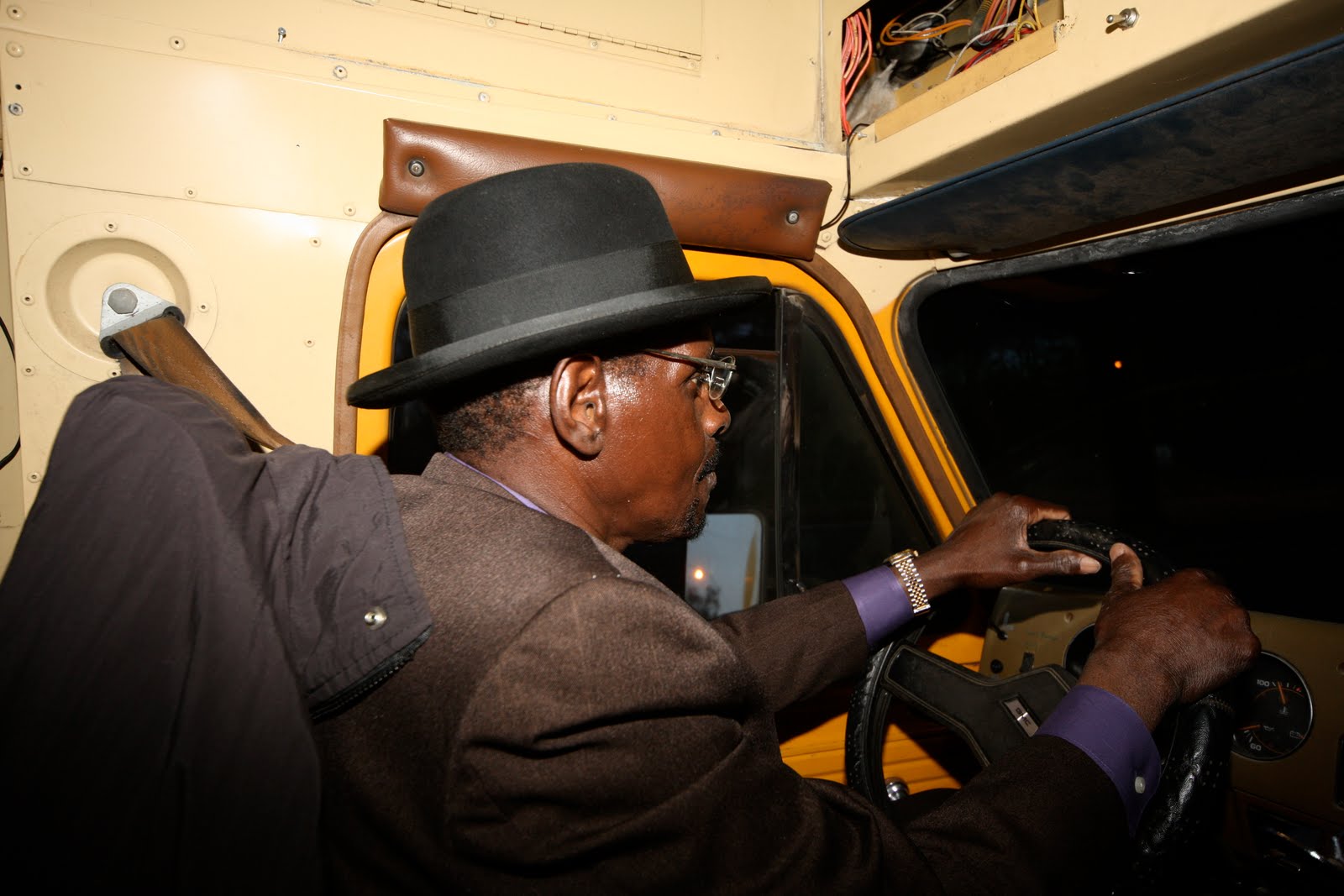
Anne Vidal looked at our driver, Johnny, his facial expression hidden by the little black fedora he'd worn all night.

"Gas gauge don't work," he replied his voice a quiet, studied calm.

We looked at each other.

Rut-roh, George.

____________________________


It had all started out  innocently enough.  It was Wednesday, and Tommy was out of town. I was in charge of feeding the cats at Shantybellum. Reaching out to unlock the door, I spied an envelope tucked into the doorjamb. Addressed to Tommy and Elodie, I opened it and pulled out a card:

"She was nobody's doormat and had the tattoos to prove it."

It was a party -- a ride  to Teddy's Juke Joint in Zachary, Louisiana, on Saturday night in a bus with other adventurous souls to listen to Li'l Jimmy Reed do his blues thang.  It was Anne Vidal's birthday and she wanted to do it up right.

Eighty miles down the Blues Highway 61, toward Baton Rouge, Teddy's is the real deal in juke jointery (Is that a word?).   Teddy, the proprietor, was born in the little shotgun house where -- dressed to the nines -- he spins his favorite tunes between sets of live music.

It's a fun, funky atmosphere with an eclectic clientele who leave their differences at the door and enjoy the music, each other and themselves amid a collection of Blues memorabilia, Christmas lights, disco balls and chaos.

Hmm....this was an offer we couldn't refuse.

Ten of us met up at Anne Vidal's little eatery -- The Pig Out Inn BBQ -- where she had the short bus prepared and waiting.  Painted a kind of nondescript brownish/gray/green, it had "Angola Bound" painted on one side and "Prison Transport" on the other.

We stepped inside and back into the 70's where three old sofas covered in scarves and tassels sat on a red Persian rug.  The smell of incense wafted  the air.  Sandwiches from Pig Out and Clara Nell's deviled duck eggs awaited us alongside an impressive collection of libations, which included coffee for Johnny, our faithful driver.

Like Anne Vidal, my dear cousin Roberta had come dressed for the occasion in a black tutu with a pillbox hat.  Her date Mitchell, sported a fancy black cowboy shirt with an upside down guitar in white piping, matching his leonine mane of striking white hair.  Anne Vidal's boyfriend, Steve, had on the pointiest pair of cowboy boots I've ever laid eyes on.  How come I never think of these things?

"What's the story on the bullet holes?" I asked, noticing the all-too-real set of bullet holes in the back window.  "What's the story on the bus, in general?"

"I bought it from somebody who had a hunting camp," said Anne Vidal.  "Somebody shot it."

"Everybody ready?  Let's go."

"We don't have no turn signals on here," said Johnny.  "And we only got one brakelight."

"Well, we've got one, anyway," said Anne Vidal.  "We'll make do.  Let's go."

We realized soon thereafter that we didn't have any inside lights either.  Fortunately, Tommy had a flashlight.  We could still find the food.  We were having a grand old time, eating those duck aigs and telling stories.  We'd passed the new prison down in Woodville, when Johnny said, "We're losing oil pressure."

We pulled into the nearest gas station and treated the engine to some oil.  Satisfied we were still roadworthy, we continued on our way, arriving at Teddy's with plenty of time to partay.

Our friend Doretta met us at Teddy's.  She'd driven up from New Orleans and looked great.  I don't think I'd seen her or Kim (who took all these pictures) since high school.

We decided to call it quits around midnight and piled back into the bus to head home.  We stopped again at the same little gas station to grab a coke and a bathroom break, then continued on our way.


About 20 miles outside of Woodville, we chugged to a stop and found ourselves in the aforementioned predicament.

"I can't believe we just left a gas station and didn't get gas," said Vidal, Anne Vidal's brother.  "Unbelievable."

"But I just filled it up," protested Anne Vidal.

"Yeah, but we took it out the other day," said Johnny.  "We drove a lot that day.  Remember?"

I was beginning to think Johnny wished he'd never agreed to this trip.

"Well, I guess it's my fault, then," said Anne Vidal.  "I should've remembered." 

I felt bad for her.  I think we all did.

"Aw, it's an adventure," I said and laughed, a bit hysterically.

I remembered a TV show on The Learning Channel I used to watch back in the 90s called Stories of Survival where people in everyday situations suddenly find themselves fighting for their lives.  I looked at Tommy.

"Did you bring your insulin?"

"Oh, God."

I don't know who said that.  More hysterical giggles.

"How can the gas gauge be broken, too?" asked brother Vidal.  "Do you even have an inspection sticker on this thing?"

"Yeah.  I peeled it off my car this morning and stuck it on the bus."

I knew Anne Vidal was smart.  I'd have forgotten to do that.

"Who can we call?"

"We could call Doretta." 

"She's halfway back to New Orleans by now,"

Somebody suggested the highway patrol.

"Nope.  Can't do that," I said, sipping on my scotch  (one for the road, you might say).  "We've been drinking."  

"But we've got a designated driver," said Roberta.

Have these people been adults so long they've forgotten how to get into trouble?

"Open container," I said.  "We'd get busted for sure."

"We could spend the night here," someone else said.

"I want to go home!" cried Clara Nell.  "I don't want to sleep on the bus.  I want to sleep in my bed!"

Her Tempurpedic bed, no less.  It's hard to feel sorry for someone who can afford a Tempurpedic mattress.  We all looked at her.

Silence.

"I'll call a tow company," said Mitchell, whipping out his phone.  Kim, ever calm, snapped photos for posterity.

"Hello?  I need you to bring us some gas right away," he said, adding, "I don't care what it costs.  We've got to get out of here.  Now!"

"Don't tell them that," Tommy protested.  "They'll think it's true!"

He could see dollar bills flying away down the highway.

"We need to get off this shoulder," he said.  "And we need some tail lights so cars won't hit us." 

"Nope.   Actually, it's better that we don't have them," I said.  "Drunks tend to aim at them, thinking they're following the car ahead of them."

"I've got a friend in Natchez I can call," said Vidal.

And he did.

"It'll be 30 minutes."

The men climbed out to stretch their legs.

"I knew I should've used the bathroom back there," said Roberta.  "I've got to pee."

I went around the front of the bus with her to make sure I could shield her should anyone drive past, memories of driving to Gulf Shores with my parents for summer vacation replaying in my head.  We climbed back in to wait for help.


A few minutes later the bus filled with light as a vehicle pulled in behind us.  I could discern some kind of lights across the top.

"Uh, oh.  I think it might be the highway patrol," I said.

The idea of trying to hide the booze was laughable.

"You sure?" asked Vidal.

He stood outside the bus, peering into the light like Richard Dreyfuss in Close Encounters of the Third Kind.

"Nope," said Vidal.  "It's a truck."

Then another truck pulled in behind it.

Mitchell and Johnny went around to the back of the bus.  Both trucks stayed where they were, their engines idling as their drivers took in the scene from about 50 yards back.

They looked at Mitchell and his upside down guitar, his white hair.  They looked at Johnny, still unreadable under his little black fedora.  They took in the bullet holes in the rear window, "Prison Transport" written on the side.

They peeled out like the hounds of the Baskervilles were after them.

I don't know for certain, but I'd bet they were thanking their maker for delivering them from a horrible fate.  A fate worse than running out of gas on the side of a road in the middle of nowhere, Mississippi.

Shew!  That was a close one, all right.

Inside the short bus, Roberta stretched across the seat and put her head in my lap.  "I'm going to sleep," she said.  "Wake me up when we get home."

We swapped stories, the atmosphere punctuated by Berta's soft snoring.  An hour went by.  Then another 30 minutes.

"I don't think anybody's coming," said Clara Nell, panic starting to rise again.

Just then Tommy pointed across the road.

"Isn't that a tow truck?"

We watched as its tail lights crested the hill and disappeared into the darkness.

"You think that was him?  He didn't see us.  Vidal!  Call him back."

He got him on the phone and told him to turn around.

He came back and brought us our gasoline and emptied it into the short bus.

"Man, I went all the way to Buffalo looking for you guys," he said, the smell of gasoline settling inside the bus.

"Buffalo,"  said Tanna, puzzled.  "Where's that?"

"New York," Tommy answered, which got a big laugh.   Well, okay.  It was funny, but I'm still funnier than he is.

With gasoline fumes thick in the air, we headed toward home.  As we turned onto Canal Street for the final leg home, we all breathed a sigh of relief, joking about what a great story it would be.  Then we ran out of gas.

Again.

Right by by the visitor's center.

"Johnny, don't stop!  We're going downhill.  See how far it'll coast."

We all leaned forward as though that would help it coast a little further as the short bus whispered hopefully, "I think I can.  I think I can.  I think I can."

We made it all the way to Rosalie and cheered as we turned into the Isle of Capri parking lot.

It was 4:15 a.m. as our hapless little crew tumbled out of the bus and onto Natchez soil.  Tommy knelt down to kiss the earth.  Oh, scratch that.  He tripped and fell.

"Ow!  Gimme the ice chest and that flashlight."

We patted Johnny on the back, thanked him profusely and tipped him well.  Call it combat pay.  We started down the final stretch to The Pig Out Inn BBQ, a block and half away.

"What's that awful smell?"  Miss Tempurpedic was not amused.

"This is where the Carriages wait to take tours."

"Ew!  I just stepped in horse pee."

As we all stumbled down the street hoping not to see any cops, an old owl in the oak tree at Rosalie watched, our voices fading into the night.

"Watch out for that pile of poop."

"Oh, lovely.  That's just great."

"Quit complaining."

"Is there any scotch left?"

"Just point me toward a bed."

"I told you you should've brought a jacket."

"Shut up."


Photos by Kim Kaiser

Sunday, March 21, 2010

Race Relations


Before I moved back to Mississippi from Los Angeles, visits home were exhausting. It was impossible to see everyone I wanted to see during the week or so I was here. Sometimes, I wouldn’t let people know I was home, as it was often just more than I could do to make time for a visit. Away from LA, all I wanted was to stay in the country where it was quiet and beautiful and serene. One of the people I always tried to see, though, was Dorothy Smoot.

Dorothy worked as a housekeeper for us for several years. She and her husband owned Smoot’s Grocery on the bluff. Dorothy was a sweet, good-natured woman who chattered a blue streak while she worked.

She was working for us when my sister came home from physical rehab in Jackson, where she’d been dealing with the grim reality of a spinal-cord injury. Depressed and upset with having to face a life very different from the one she’d always imagined, my sister was a captive audience for Dorothy’s chatter, and sometimes snapped at her.

But Dorothy meant well, and was doing things for all of us that many people wouldn’t have done, so I went out of my way to be nice to her. At first, I’ll admit it might have been simply guilt, but soon Dorothy and I got to really know each other and became friends. She loved me and I loved her.

When I brought my new baby girl home for the first time, she brought her own two daughters – Patrice and Kamill — out to the house. One was in junior college and one in high school. After her husband’s death, Dorothy did what she had to do to give her girls a home and an education, and she did a damned good job.

Still heavy with the weight I’d gained during the pregnancy, I started down the back stairs to meet them. About halfway down I overheard Dorothy talking to her girls.

"I wants you to meet Miss Elodie. She be so nice."

Smiling, I came into the kitchen to give Dorothy a hug and meet the two beautiful little girls of whom she was so proud.

"Oooweee! Miss Elodie, lookit you. You done got fat! Ain't she fat? Lookit them thighs! Don't she look fine!"

I’ve always had a problem with my weight. And a comment like that from anybody else would’ve made me burst into tears, but I knew she’d meant it as a compliment. I had some donkadonk in my badonkadonk. It was funny and sweet, and I laughed and agreed on how fine I surely looked.

Fortunately I'm not quite so "fine" anymore. Not that anybody would rush me off to the anorexia clinic, but at least I don't waddle. Her daughters were beautiful and well spoken and Dorothy had every right to be proud of them. They were both straight-A students and one of them had just gotten a scholarship. The other was about to join the armed services.

Dorothy always baked a German chocolate cake for me when I came home. I guess she wanted to make sure I kept my badonkadonk in good order. Over the years, we exchanged Christmas and Easter cards with pictures of our respective children and news of our families and lives.

In 2006 I came home to visit. I’d been home several times in the last couple of years and had been so busy with hasty family business and other long-forgotten excuses that I hadn’t called Dorothy. And I felt guilty about it. So on this particular visit, I’d just gotten home. It was Friday evening, and Daddy and I were driving around town.

I loved those drives with Daddy, listening to his stories. I’d bring a little voice-activated tape recorder and surreptitiously turn it on, and set it down on the seat between us, hidden under a magazine or a scarf.

“You see that house up there on the hill,” he’d say.  “Your great-great grandfather built that. It was a boarding house.”

Riding along, he’d point to another house: “The woman who lived there had a child that no one knew about.”

I’d heard the stories before, but I loved them even in the retelling.

“An old colored man told me that,” he’d say. "I used to work on the river with them years ago,” he’d continue. “They told me things they wouldn’t tell other white folks.”

“That reminds, me,” I said, “Don’t let me forget to call Dorothy in the morning. I didn’t call her the last couple of times I was home, and I feel bad about it.”

He promised he would.

Every morning Daddy walks down the long gravel driveway to the front gate to pick up the paper and get a little exercise and Saturday morning was no different. I was upstairs checking my e-mail when I heard the slap of the front-door screen.

"Elodie? Where are you?"

"Up here!"

Daddy came upstairs and handed me the paper, a grim expression on his face.

Obituary: Dorothy Smoot Natchez -- Funeral arrangements for Dorothy Smoot, 72, of Natchez, who died Thursday March 9, 2006, in Plano, Texas, are incomplete at Webb Funeral Home.

I looked up Dorothy’s Natchez phone number and called it. Her daughter, now grown and with children of her own, told me Dorothy had moved to Dallas to live with her, where she taught school. A few months earlier, she'd learned she had colon cancer.

"Mama was doing fine until just about a month ago, and then she just went downhill real fast."

“I was just about to call her to say hello,” I said, my voice breaking. “I was just going to invite her over to visit. Oh, I’m so, so sorry.”

Daddy and I went to the viewing the next day, and Dorothy looked good. I've always thought that was such a weird thing to say about someone who's dead, but you know, it’s comforting somehow to be able to see a person one last time and have them look in death the way they looked in life.

Her children were there and seemed genuinely pleased that we'd come. They made a big fuss over Daddy, who never seems to age, and who clearly enjoys being told so.

Although it had been a good seventeen years or so since they'd seen him, they knew him the second he walked in, and talked about how they used to enjoy listening to his stories, which were always entertaining and somewhat scandalous. They still are. I guess while I was in Los Angeles, he’d gotten to know Dorothy and her children even better than I had.

It was nice to see them. They were all grown up and had two beautiful children with them. Daddy and I were the only white people there.

Right after we arrived, a wizened old woman came in, pushing a walker accompanied by her son. She looked ancient and tiny and fragile. Tricia, the younger daughter, turned to her sister and said, "Oh, look, Kamill. It's Miss Elodie."

Well over a hundred years ago, my great-great grandparents were slaveowners. Thomas Rose was a master carpenter. It was he who designed and built Stanton Hall here in Natchez. Occasionally, he would give parties at his house for his slaves called darkey balls, inviting other slaves from the area. He had a daughter named Elodie.

I’m told that sometimes slaves would name their children after their owners, and I’ve heard that although I am one of only two white women in town named Elodie, there are a number of black women, most of them elderly, who also bear the name.

Standing there with the old woman, I felt a connection with history that was almost electric, one part guilt, but also one part kinship and the gladness that comes from knowing things can change. I wanted to say something to her, but she didn’t know me and would have only thought it strange.

We stayed a little while. My father spoke to several people he knew. Several came up to speak to him whom he couldn't place, but at 80 years old, that's to be expected. But they were glad to see him, enthusiastically shaking his hand and reminding him of how they knew each other. I was glad we went, and Daddy was, too.

We went out afterwards for a drink on the bluff overlooking the river, a shining silver ribbon down below.  We were in a building another great-grandfather had once owned, and watched as the sky turned that color of pink one finds on the inside of conch shells -- color and history all around us.
* Photograph, unknown.  I wanted to find a photo of Dorothy, but I haven't been able to yet.  When and if I do, I'll replace this one.

Sunday, March 14, 2010

Natchez Pilgrimage, 1939


  For the past couple of weeks, a little-known short film about the Natchez Pilgrimage has gone viral among present and former Natchezians. At eight minutes long, it's a brief but fascinating look back to the origins of those wonderful, strange and touching rituals known as the Natchez Pilgrimage and the Tableaux.

Watching this film, I realized not only how much Natchez and many of its traditions have remained constant over the years, but also how much has changed. Yes, little boys and girls still dance around the Maypole for tourists to the same music they did 60 years ago, but no longer does anyone give credence the stereotypical, dancing, lighthearted Negro portrayed in the film. There's something good in both of those things.

A few days after seeing it, I ran into one of my parents' contemporaries, Kathie Blankenstein. I asked if she'd seen it. Not only had she seen it, she'd participated in it. I asked her if she would mind sending me any information she might have about the movie.

"I do, in fact, know a good bit about this film," she said in a follow-up email.

It was Kathie's mother, Lillie Vidal Boatner, who was largely responsible for getting the film made.

"This was at a time when the Natchez Garden Club and the Pilgrimage Garden Club were sparring with each other," said Kathie. "Each had half of the month to present the Pilgrimage. Mother was the executive secretary for the Natchez Garden Club, and she and the president of the club, Mrs. Joseph (Harriette) Dixon were in charge of getting publicity to have tourists visit during their club’s dates of Pilgrimage.

James A. Fitzpatrick was a movie producer, director, writer, and narrator, who specialized in filming travel documentaries, which MGM distributed as a series called "Fitzpatrick Traveltalks" and "Voice of the Globe." They were entertaining shorts that usually played just before the feature film in movie houses all over the United States and abroad.

"They dared ask Metro Goldwyn Mayer to include Natchez in its Voice of the Globe series," said Kathie. "As a result of the badgering by these intrepid ladies, MGM agreed to send Fitzpatrick and his crew to Natchez."

According to Kathie, the resulting movie was recorded in five different languages and was shown in 17,000 theaters throughout the world.

Fitzpatrick was so impressed with Natchez he persuaded Hollywood to return him here to film background scenes for Gone With The Wind.

In 1982, Kathie's mother wrote MGM and asked if they would lend her a copy of the film so that she chould show it at a Natchez Garden Club meeting. After much correspondence they agreed to lend her a copy.


"I remember how excited we were to open the package," said Kathie. "We found that film was only able to be shown on regular movie theatre projectors, so she had to arrange for it to be shown at the local cinema."

Years later, Turner Broadcasting obtained the rights to all of Fitzpatrick’s Traveltalks from MGM.

"In 2002 I obtained a video copy from someone I knew who worked for Turner. I used it, along with several other films of the Pilgrimage, including some of Dr. Benoist’s home movies, for a Natchez Garden Club program I was responsible for."

Thanks to Kathie's generosity, all of you who've been wondering who these long-ago participants are can satisfy your curiosity with a scene-by-scene breakdown of the film.   If anyone knows who might be able to give us the identities of the African-Americans in the film, please let me know.  Enjoy.

OPENING SCENES: Mississippi River; Learned’s Lumber Yard; Ferryboat before bridge was built;

DOWNTOWN: Court House (red roof); Notice Priest’s House across Market St. before NGC moved it; Salvo & Berdon Candy Co., now gone; Main St. toward river – old Fire Station now gone.

SCENES OF HOMES: “Dunleith” ; “Rosalie”; “Ravenna”; “The House on Ellicott Hill” then called “Connelly’s Tavern” - lady raising flag and saluting is Blanche Robinson. Couldn’t identify others.

“Edgewood” – PICNIC SCENE with children. TEAPARTY SCENE Left to Right: standing – Jeff Lambdin, Waldo Lambdin; seated -Harriet Geisenberger Shields, Kathie Boatner Blankenstein (serving tea); Clare Geisenberger Eidt (walking up w/cookies); couldn’t identify other children playing “Ring Around the Rosie”.

“Inglewood” front steps- couldn’t identify ladies; “The Briars” exterior, interior with stairway & piano; “Melrose” interior. Elderly African American (seated) in red bandana with child is Jane Johnson who lived and worked at “Melrose” for many years.

1939 TABLEAUX REENACTED ON LAWN AT “MELROSE”:

“The Hunt” – Hounds used in those days usually were those of Mr. Toto Passavanti. Many Natchez businessmen participated in the Hunt tableau.

Martha Hootsell dancing as “Audubon, the Dancing Master.”

Other dancers are the “Royal Ballet” trained by Miss Treeby Poole. Dancers include Marie Zuccaro Perkins, Agnes Whit, Catherine Ashford, Mary Regina Prothero, Margaret Laub Cooper, Willie May Nichols, Helen Feltus; Children coming down steps include Harriet Geisenberger Shields (in hat) & Ann Metcalfe Lanneau (dark curls). King and Queen (called “Bride and Groom) are Marjorie Hogue Hodges and Hicks Parker. Page was Albert Metcalfe. Margaret White in court.

FINAL SCENE - Sunset over Mississippi River. Couple are Tom Green and his sister Isabelle.

Okay that last scene was of siblings?  That’s just wrong in so many ways. No wonder everybody wonders whether you’ll still be cousins after the divorce.


Monday, February 22, 2010

Matters Familias ~~ Howard Pritchartt ~~ Adventures in World War II

*Photo by Hannah Reel for The Natchez Democrat.  Republished with permission.

With an article coming up in The Natchez Democrat as well as a recently published article in Country Roads, my dad, Howard Pritchartt, Jr., is getting quite a bit of exposure this month.  The following is a video by Natchez resident Bill Slatter, who is interviewing World War II veterans in the area.

Click on the links to see the other stories.

Video created and produced by:

Bill Slatter Video Productions
423 Main Street
Natchez, Mississippi 39120
(601) 446-9401

Many thanks to Michael Norell for putting it on You Tube for me. I owe you one, Michael.